There are some amazing parallels between color theory and music. The color wheel is a basic tool from color theory that shows the relationship between the colors of the rainbow. Colors directly across from each other are called complementary colors and tend to give the most striking contrast.
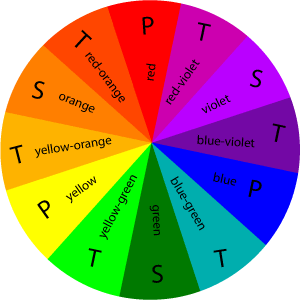
These colors may be combined using various color schemes - each giving its own sort of “feel”. If each of these colors is now associated with a note from the chromatic scale, then it turns out that the way a color scheme is perceived is very similar to the way the associated note combination is perceived.
Yellow → C
Yellow-orange → C#/Db
Orange → D
Red-orange → D#/Eb
Red → E
Red-violet → F
Violet → F#/Gb
Blue-violet → G
Blue → G#/Ab
Blue-green → A
Green → A#/Bb
Yellow-green → B
This “mapping” is somewhat arbitrary and could be shifted, provided the order is maintained. Is C a “yellow” note? I don’t know, but perhaps somebody who experiences synesthesia would have a preference. Here are some examples of color combinations and the associated note combinations:
Monochromatic / single note
A single color or a single note is generally uninteresting (unless you really just love that color/note).
Analagous / dyad
An analagous color scheme uses two nearby colors on the color wheel. It is much more interesting that a monochromatic color sheme. A dyad consists of two notes, again this gives much more interest than a single note.
Complementary / tritone
A complementary color scheme is very striking and gets your attention. It is good for adding interest, but a little goes a long way. In music, the tritone is the most dissonant of intervals and is used sparingly to create tension.
Split complementary / chord
Rather than using the color directly across on the color wheel, a color on either side is used. This creates a pleasing combination without the stark contrast of the complementary color scheme. Similarly, a musical chord creates interest, potentially even more than a dyad, while not being as dissonant as the tritone.
December 30th, 2008 at 3:00 am
[…] Hephaestus Audio » Blog Archive » Color Theory and Music […]
July 29th, 2010 at 1:18 pm
[…] got the colors from this color wheel. Â http://hephaestusaudio.com/delphi/2008/12/29/color-theory-and-music/ Comments RSS […]
April 2nd, 2011 at 8:59 pm
[…] color theory color wheel hephaestusaudio.com […]