Archive for the ‘Psychoacoustics’ Category

Break In Period

Friday, April 3rd, 2009

board-breaking

Most audiophiles agree that there is a certain “break in period” required for audio gear to start sounding right.  Most non-audiophiles will agree that this is the case for something like a loudspeaker, where there is a measureable change in the driver parameters after loosening up a bit, but tend to regard break in phenomena in audio electronics with great skepticism.  Most audiophiles point to the usual suspects: resistors, capacitors, and magnetics.  This is a good start, but there is a bit more to it.

There is a great exhibit at the Exploratorium in San Francisco.  It consists of a basketball, a hoop, and a pair of funky glasses that skew your vision to one side.  You start by making a few shots without the glasses – no big deal, the hoop is fairly close.  Next you put on the glasses and every shot now goes off to one side – a very strange sensation!  However, after several shots you notice that each shot gets a little better as your brain starts to slowly adapt to this new “reality”.

Much like the illusion given by the funky glasses in the basketball exhibit, every piece of audio equipment is nothing more than part of an ”illusion engine”.  Since the musical reproduction we are creating is an illusion, our brain must learn how to perceive it correctly for the illusion to work at all.  This is a significant part of the break in period for audio gear – we are breaking in, right along with the equipment!

Every piece of audio gear has errors, regardless of typical ”perfect sound forever” claims.  Some errors are easier for your brain to adapt to than others.  A longer break in period may in part be the result of errors that require a bit more “training”.  Note that the amount of training needed is also a function of the individual.  Some listeners may readily forgive certain types of error (e.g. dynamic compression), while being hypersensitive to other types of error (e.g. poor imaging).

ABX Testing and the Heisenberg Uncertainty Principle

Sunday, March 29th, 2009

ABX testing is a form of audio testing where two components (A and B) are carefully matched with respect to level, some means is included to at will switch between the two during the course of a musical passage, and the listener is completely unaware of which is which (X).  This is the “de facto” standard for serious audio testing.  It is an excellent approach in principle, however there is a serious flaw: it only allows for the detection of gross differences due to the relatively brief samples involved.

The Heisenberg Uncertainty Principle in its most common form states that:

\Delta x\Delta p\geq \frac{\hbar}{2}  

Where \Delta x is the uncertainty in position, \Delta p is the uncertainty in momentum, and \hbar is Plank’s constant divided by 2\pi .

There is another form that gives the same relationship for energy and time:

\Delta E\Delta t\geq \frac{\hbar}{2}

Where \Delta E is the uncertainty in energy and \Delta t is the uncertainty in time.

What does this have to do with ABX testing you may ask?  Well, nothing actually, as the principle does not apply to the macroscopic world due to the extremely small value of Plank’s constant.  However, it provides insight to the issue of ABX testing.  I propose that there is a similar relationship between the perceived difference and the listening interval.  Let’s denote this as follows:

\Delta \varepsilon \Delta \tau \geq k

Where \Delta \varepsilon is the uncertainty of the listener as to whether a difference exists or not, \Delta \tau is the interval during which the listener compares the two components, and k is is a listener-dependent constant (i.e. it is larger for “tin ears” and smaller for “golden ears”).

The bottom line is that a given listener will be able to detect finer and finer differences between two components over time.  This means you really have to “live” with a component for some time to appreciate the subtle differences between it and another component.  Unfortunately, it is very difficult to be objective with a long term test such as this, but I have no doubt that somebody will ultimately figure out a way of doing it.

Precedence Effect

Monday, December 15th, 2008

precedence-effect

The precedence effect is a particularly important psychoacoustic effect for audio systems.  Based on arrival time, a given sound is broken up into three distinct bands:

t < 5mS

This is the first arrival interval.  It is essential for localization.

5 mS < t < 30mS

This is the integration interval.  Any additional sound that has the same “nature” as the original will be integrated and will not affect localization information.

30mS < t

This is the interval beyond the domain of the precedence effect.  Any additional sound that has the same “nature” as the original will be perceived as a quick echo.

What does this mean for audio system design?  For pro audio applications, it allows for sound reinforcement - for example public address.  The source itself may be much lower level than the reinforcement, but as long as the source precedes the reinforcement by about 5mS to 30mS, the source will still be perceived as the origination of the sound.  For audiophile applications, it means that a loudspeaker should have minimal stored energy if there is to be any hope of presenting a stereo image.  Also, diffraction should be minimized, as this produces multiples sources with an arrival time that falls within the 5mS window – thereby confusing localization.

Auditory Illusions

Tuesday, December 2nd, 2008

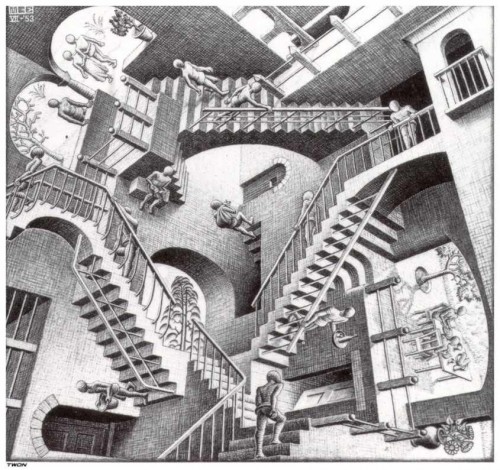
MC Escher Relativity

Much as optical illusions teach us a tremendous amount about how our vision works, auditory illusions provide the same sort of insight as to how our hearing works.

Illusions are a great learning tool because they are both fun and memorable.  Dianna Deutsch has developed some particularly interesting and revealing auditory illusions.

The knowledge of this and other elements of psychoacoustics is essential for audio design, so put on your headphones and enjoy!

ñèàëèñ èíñòðóêöèÿ
âèàãðà êóïèòü ÷åëÿáèíñê
ëåâèòðà êóïèòü
ëåêàðñòâåííûå äæåíåðèêè
äæåíåðèê âèàãðà ñîôò
ñèàëèñ ôîðòå
ïðèåì ëåâèòðû
ëåâèòðà ñèàëèñ êóïèòü
äæåíåðèê íîøïû
ïðèåì ëåâèòðû
äæåíåðèê ðîàêêóòàí
äæåíåðèêè ñïèñîê ïðåïàðàòîâ
ëåâèòðà è àëêîãîëü
äæåíåðèê ñèàëèñ ñîôò
äæåíåðèê ñèàëèñ îòçûâû
ïðîèçâîäèòåëè äæåíåðèêîâ
êóïèòü ëåêàðñòâî âèàãðà
âèàãðà êóïèòü êóðüåð
äæåíåðèêè âèàãðà ñèàëèñ ëåâèòðà
æåíñêàÿ âèàãðà èíñòðóêöèÿ
äæåíåðèê æåíñêàÿ âèàãðà îòçûâû
ñèàëèñ èëè âèàãðà
ïðåïàðàò ëåâèòðà
êóïèòü âèàãðó ñïá
ëåâèòðà îïèñàíèå
ñïèñîê äæåíåðèêîâ è îðèãèíàëîâ
êóïëþ ñèàëèñ
äæåíåðèê âèàãðà êóïèòü
äæåíåðèê æåíñêàÿ âèàãðà
ìóæñêîé ôîðóì î âèàãðå ëåâèòðà
âèàãðà êóïèòü êóðüåð
ëåêàðñòâî ñèàëèñ
êóïèòü âèàãðó â êèåâå
êóïèòü âèàãðó â èíòåðíåò àïòåêå
âèàãðà íå êóïèøü ëþáîâü
äàïîêñåòèí äæåíåðèê
äæåíåðèêè ñïèñîê ïðåïàðàòîâ
êóïèòü âèàãðó â ìîñêâå
êóïèòü âèàãðó äåøåâî
çàêàçàòü ñèàëèñ
ñèàëèñ
ëåâèòðà ñòîèìîñòü
êóïèòü ëåêàðñòâî âèàãðà
æåíñêàÿ âèàãðà êóïèòü â óêðàèíå
êóïèòü âèàãðó îíëàéí
îïòîì äæåíåðèêè
êóïëþ âèàãðó â ìîñêâå
ìóæñêîé ôîðóì î âèàãðå ëåâèòðà
ñèàëèñ ñîôò
êóïèòü ëåâèòðó â àïòåêå